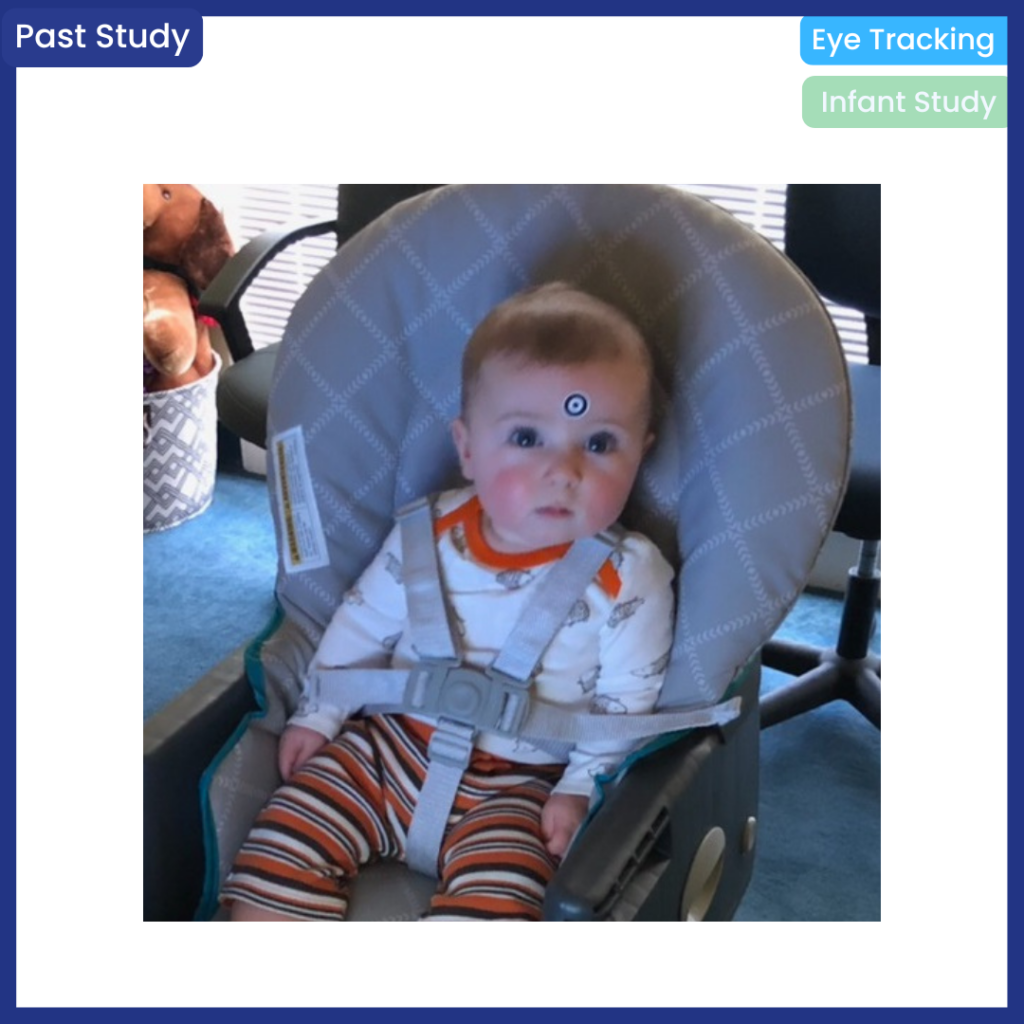
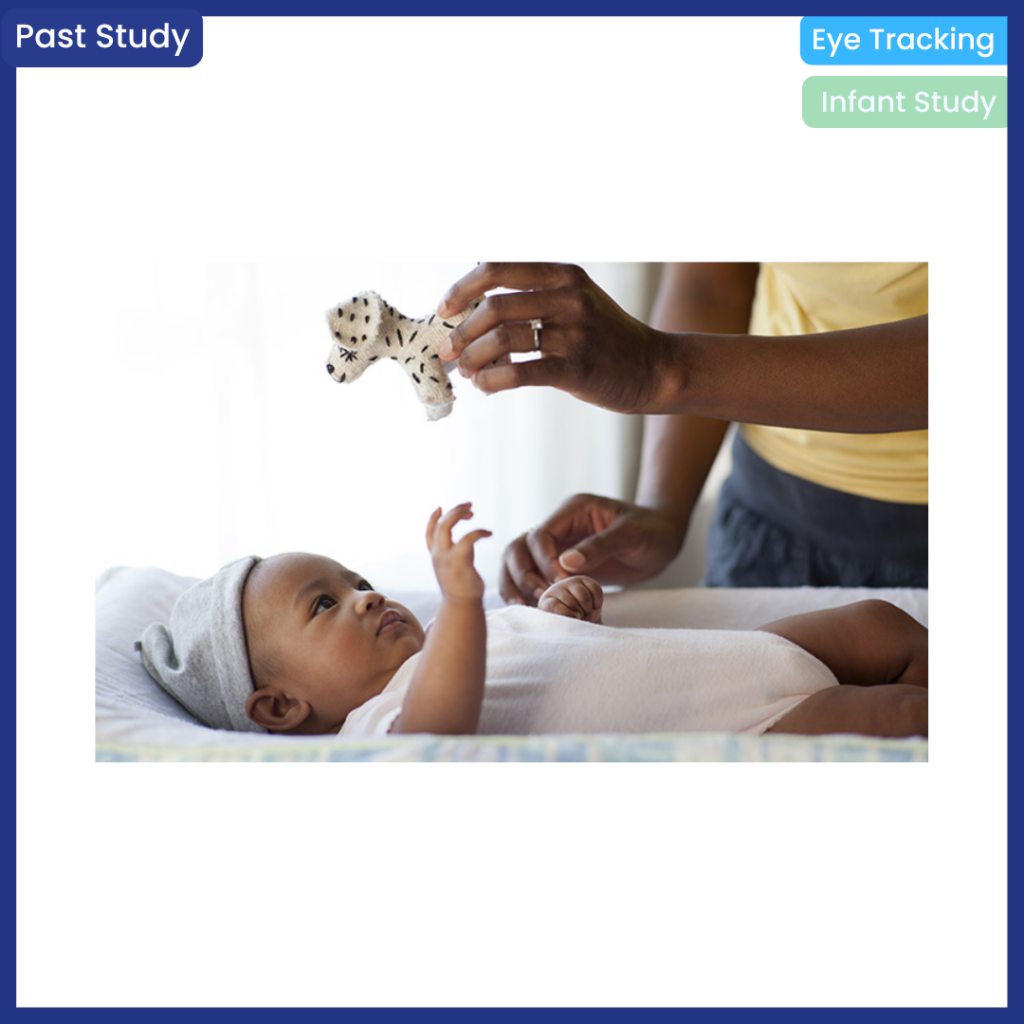
Infants learn in environments full of competing sights and sounds. Our work looks at how attention helps them stay focused on what’s important and supports learning in real-world settings.
How do infants develop attention to faces?
Ages: 6- and 11-month-old infants
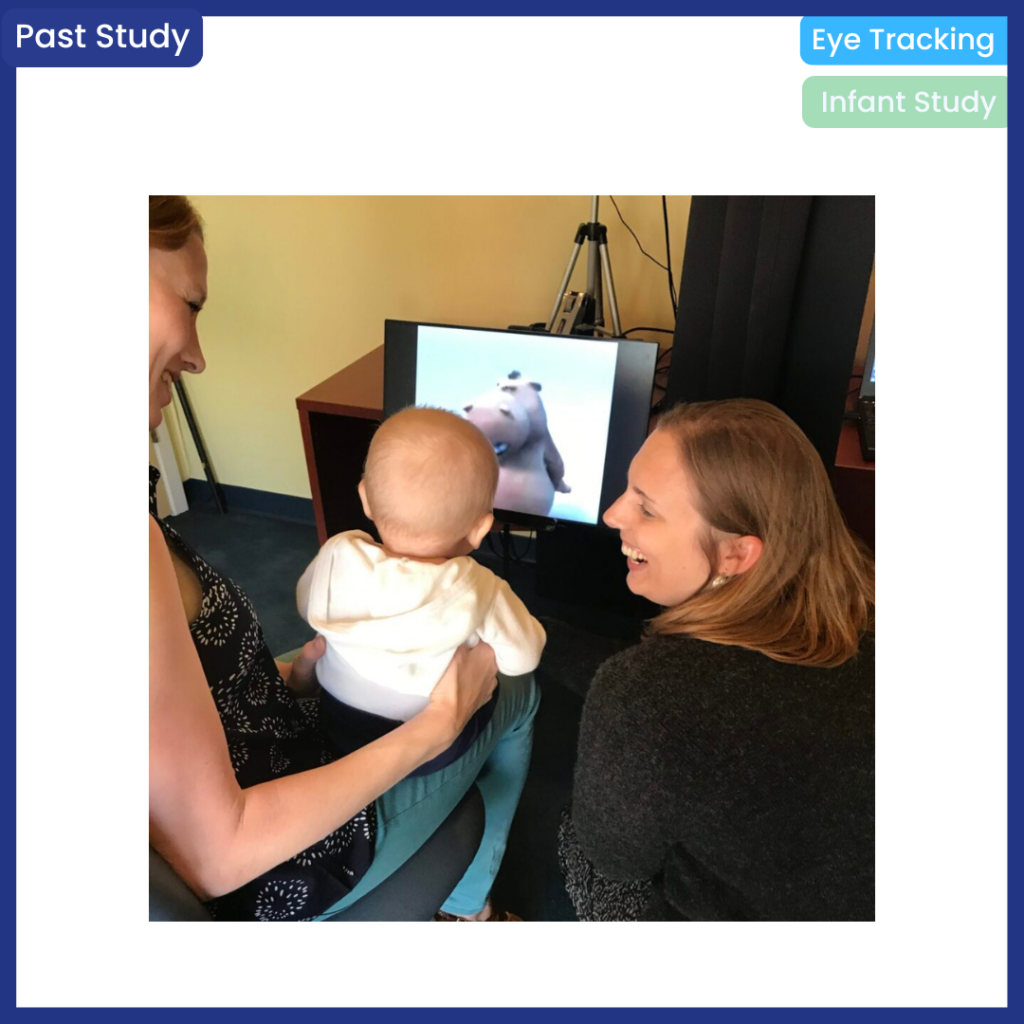
Infants viewed images of faces while their eye movements were recorded with a safe, non-invasive eye tracker. This study examined how quickly infants orient to faces and how long they maintain their attention. The findings provide insight into the early development of social attention and how infants begin prioritizing socially relevant information. These foundational attention patterns support later communication, learning, and social engagement.
How do infants develop biases for familiar versus unfamiliar faces?
Ages: 0-9 months old
Infants develop face-processing biases through ongoing interactions between attention and perceptual learning. Early on, bottom-up attention draws infants to faces and supports learning from frequent exposure, which then influences how they later focus on familiar versus unfamiliar faces. Over time, these processes help fine-tune how faces are perceived and contribute to the development of the
How does socioeconomic status interact with attention to shape memory in infancy?
Ages: 9-month-old infants
This study shows that socioeconomic status can influence memory as early as 9 months, with higher-SES infants showing stronger recognition memory. However, this effect depends on how infants are paying attention. When infants use spatial selective attention, the SES gap in memory disappears. However, when learning relies on more basic attention, lower SES is linked to weaker memory. SES didn’t affect attention itself, only memory outcomes based on the type of attention used during learning. Overall, the findings suggest that selective attention can help protect early memory byimproving how information is encoded.
How does the development of selective attention affect early learning in infants?
Ages: 4-month-old infants
This study found that how infants pay attention affects how well they learn. At 4 months old, infants who used more advanced selective attention learned cat and dog categories better than those using simpler attention. These infants also didn’t rely as much on prior experience, like having pets at home. But infants with simpler attention needed that kind of experience more to learn. Overall, better attention skills helped improve early learning and memory.
How does attention influence the development of the other-race effect in infancy?
Ages: 9-month-old infants
This study looked at why babies get better at recognizing faces from their own race but worse at telling apart other-race faces. Researchers used a task to guide 9-month-old infants’ attention to either own-race or other-race faces. Infants could tell faces apart in both groups, but only the faces they focused on were learned well. This means the difference isn’t about the faces themselves, but about where infants are paying attention. Overall, attention plays a big role in how babies learn to recognize faces
How do genetic differences influence infants' attention and responses to new experiences?
Ages: 7-month-old infants
This study looked at whether a gene called COMT (Val158Met) is linked to how infants balance focus and flexibility. In 7-month-olds, different versions of the gene were tied to different behaviors: one group showed more interest in new things and faster reaching, while the other showed better attention control and stronger responses when things changed. Overall, the results suggest that even in infancy, genetic differences may influence how babies focus on information versus how easily they shift attention to something new.
How do genetic differences influence infants' ability to shift attention?
Ages: 7-month-old infants
To understand early attention development, this study looked at whether genetic differences related to dopamine and acetylcholine affect how 7-month-old infants pay attention. Researchers focused on how babies orient attention in a spatial cueing task, including both simple orienting and a more advanced form called inhibition of return (IOR). Infants with a certain version of the COMT gene showed stronger IOR, while other genes (related to acetylcholine and dopamine transport) were not linked to attention differences. Overall, the findings suggest that early differences in dopamine function may shape how infants control and shift their attention.
What is the relationship between attention and memory in infancy?
Ages: 9-month-old infants
Inhibitory attention mechanisms support memory by reducing distraction during encoding. Infants showed stronger learning and better category recognition when attention involved suppression compared to when it did not. In contrast, infants in the facilitation condition did not reliably distinguish between familiar and novel items at test. Overall, the findings suggest that early-developing inhibitory attention plays an important role in improving memory by supporting more effective encoding.
How does attention to faces in cluttered scenes change across development?
Ages: 4-months to 24-years old
This study looked at how attention to faces changes from infancy to adulthood. Using eye-tracking, researchers showed people natural scenes with faces that were either visually salient or not. They found that very young infants didn’t strongly use visual salience to find faces, but after about age 1, people became much more likely to quickly focus on the most visually noticeable faces. The results suggest that attention becomes more guided by visual features as the visual system develops, and that early life experiences can also shape how people orient to faces in complex scenes.
Sometimes extra information helps learning, and sometimes it gets in the way. This work shows that it depends on how well children can control their attention and what the extra information is about. When kids focus on details that relate to the goal, learning can actually improve. However, unrelated distractions make learning harder. The takeaway: good learning environments aren’t just quiet — they help children notice important information.
Do kids learn from information they weren’t told to look at?
Ages: 4-8 years old
Children often notice more than the target they’re searching for. In this study, kids remembered objects better when they appeared around the target — but only if they naturally kept exploring after finding it. Children with stronger attention skills gathered more useful information from the scene. Learning here wasn’t accidental — it depended on how they chose to look around.
Not all distraction is bad. When extra items are meaningful, children remember more later on. When extra information is irrelevant, memory suffered. This study shows that the brain doesn’t simply block distractions… it evaluates them. Whether kids learn depends on how attention filters what’s worth keeping.
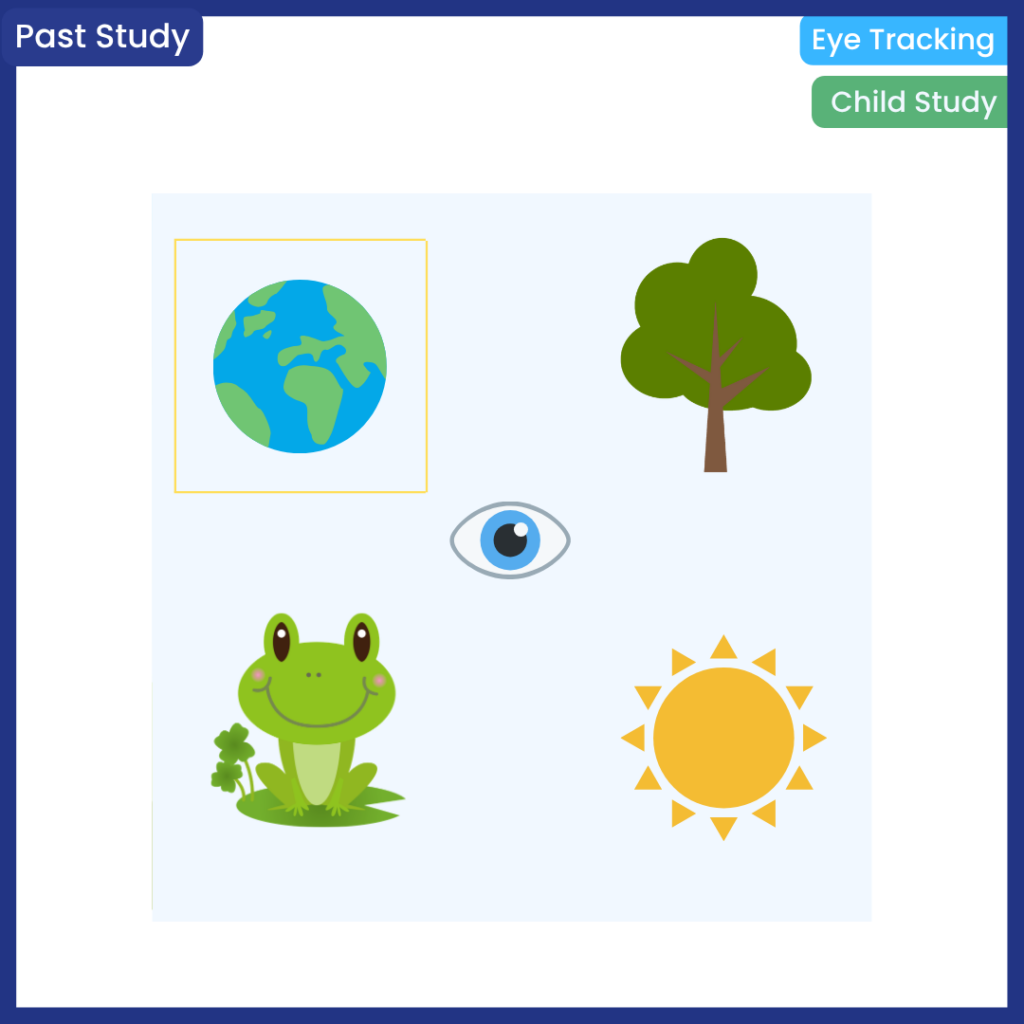
In this study, 3-5 year-old children viewed four short science lessons on a computer screen while images related to science also appeared on the screen. We used an eye tracker to record children’s looking as they viewed the lessons and children answered questions before and after the lessons to assess their learning of lesson content.
In this study, we examined how children’s attention skills support learning from relevant information in the environment. We asked 4-8 year-old children to play three computer games in which they were asked to search for and remember food images that appeared on a computer screen. We then used an eye tracker to record children’s looking as they viewed the images. We found that children’s recognition memory depended on individual differences in selective attention and time spent scanning the relevant non-targets.
In this study, we examined how children’s attention skills support learning from relevant information in the environment. We asked 7-8 year-old children to play three computer games in which they were asked to search for and remember food images that appeared on a computer screen. We then used an eye tracker to record children’s looking as they viewed the images.
Real environments are visually crowded. Using eye-tracking, this study followed how children look around complex scenes. Younger children’s attention is pulled automatically by noticeable features, while older children become better at directing their gaze intentionally. Over time, attention shifts from reflexive looking to purposeful exploration — a key step toward independent learning.